
How are the territorial division of labor and the regional urban network interrelated? Is it possible to evaluate this based on a region’s main productive chains?
I conducted my Master’s research, analyzing the relationship between spatial production circuits and the urban network of the Vales Region in Rio Grande do Sul.
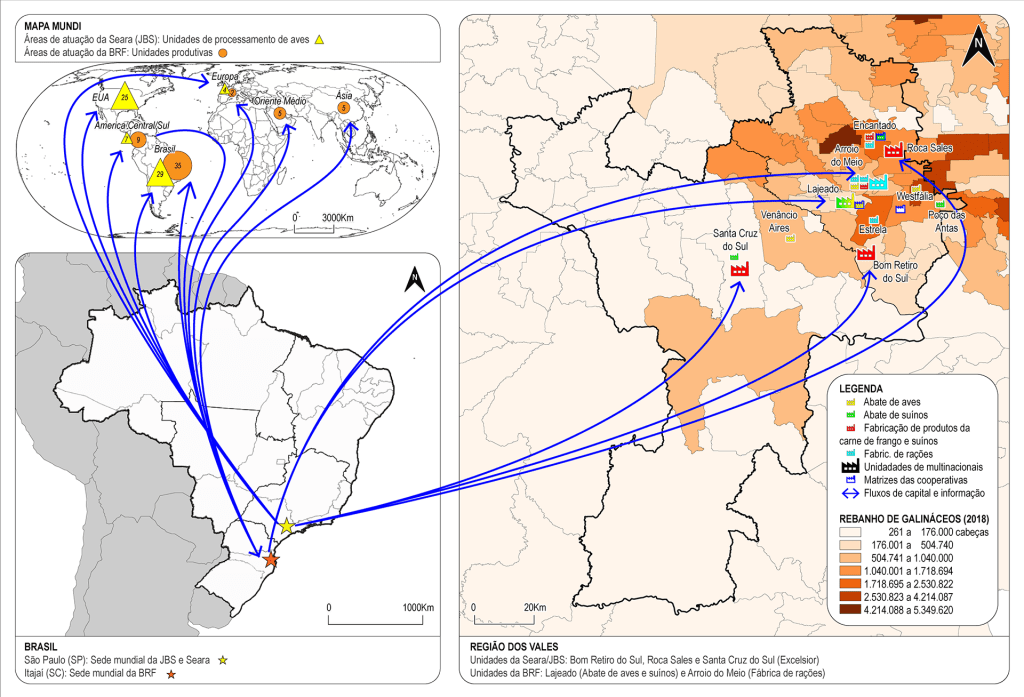
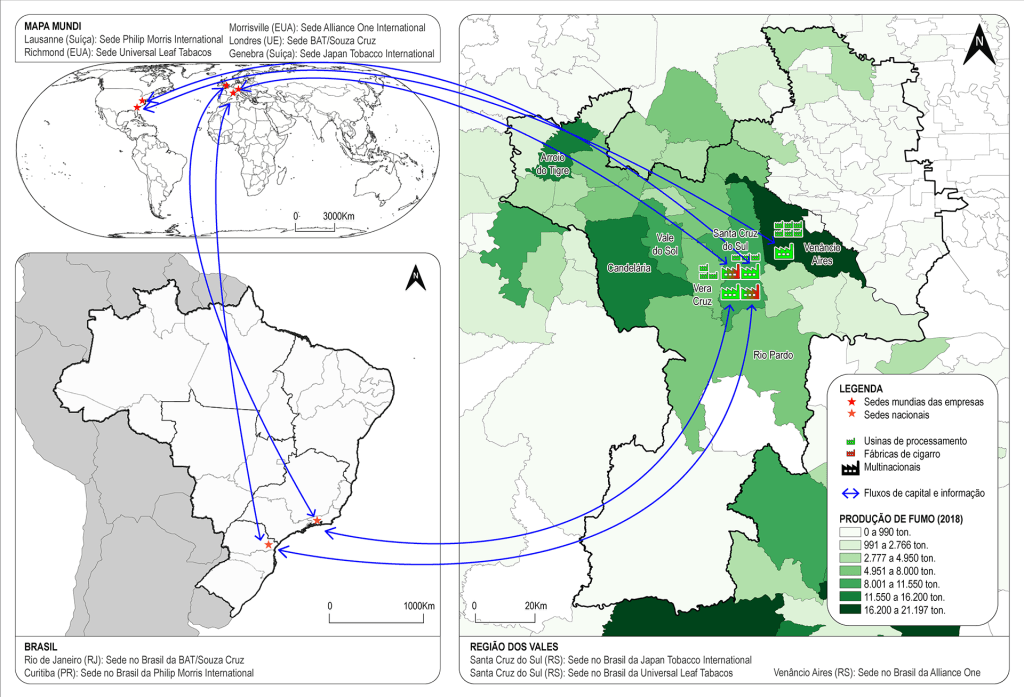
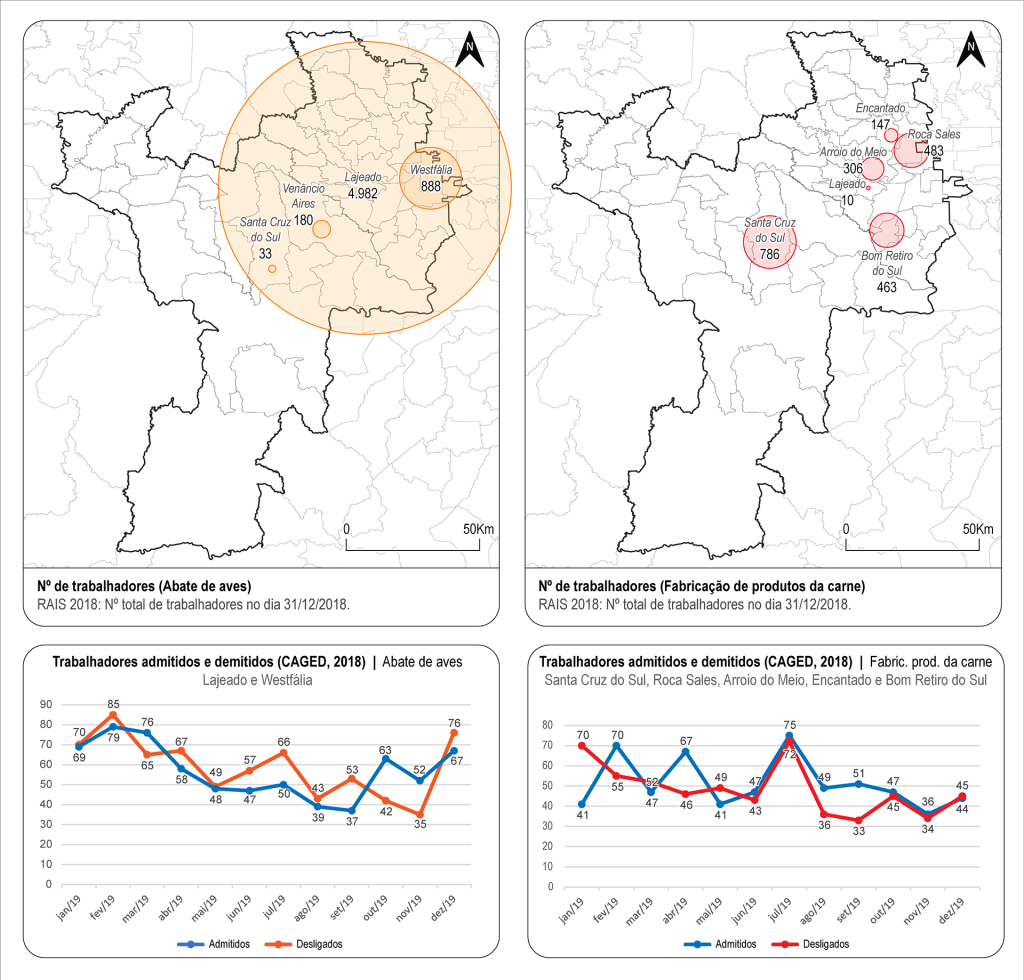
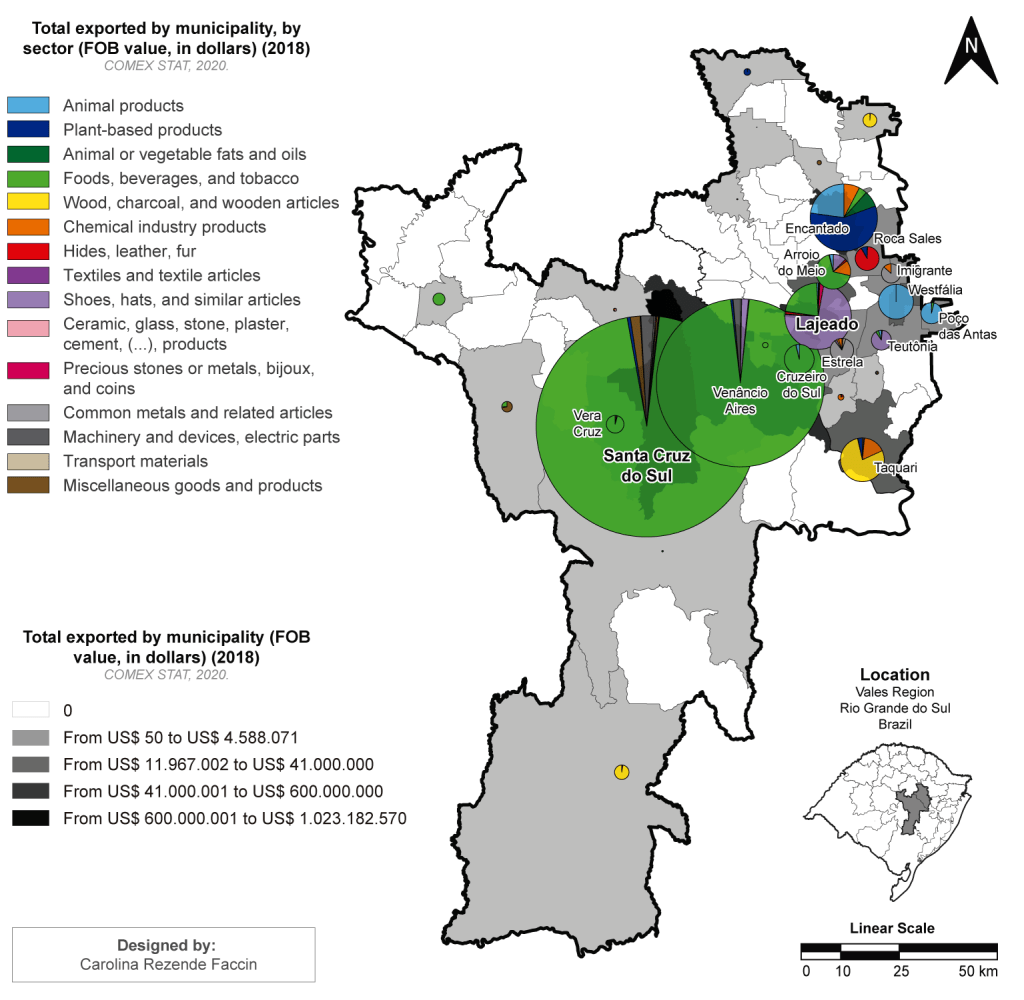
Methodology: Data analysis, geoprocessing techniques, design, documentary and bibliographic research were used, creating more than 30 maps that illustrate this interrelation.
Conclusions: The dissertation demonstrated that the territorial division of labor reflects and conditions the regional urban network, through a comparative analysis between two sub-regions: the Taquari Valley and the Rio Pardo Valley.
- The Taquari Valley has a polycentric urban network, due to the distributed activities of the poultry production chain.
- The Rio Pardo Valley has a monocentric urban network, due to the location of tobacco agribusiness establishments, concentrated in only two cities.
Contributions: The thesis deepened the methodological discussion on regional studies and generated insights for the development of public policies that consider the difference between regions.
Data Sources: RAIS, CAGED, IBGE, COMEX/STAT, Documental Research.
Tools: QGIS, Adobe Illustrator, Excel.
Publications:
- Faccin & Silveira (2021) (pt/br): Interrelational analysis of the territorial division of labor, the tobacco and poultry chains, and the urban network of the Vales region in Rio Grande do Sul.
- Faccin & Silveira (2024) (en): Study on global spatial interactions from medium and small cities, through export and import flows.


 Carolina Faccin